How DataDustie handles personal information under South Africa's Protection of Personal Information Act (POPIA): what we collect, why, where it goes, how long we keep it, and the rights you have.
1. Who we are
DataDustie is a document-processing service at app.datadustie.com, made by Digera (“Digera”, “we”), based in South Africa. This policy is written to meet the Protection of Personal Information Act, 4 of 2013 (POPIA). Where the EU General Data Protection Regulation (GDPR) applies to you, we apply the same protections.
2. Two kinds of information, two roles
- Your account. Your name, email address, billing details and how you use DataDustie. For this, Digera decides what is collected and why: under POPIA we are the responsible party.
- The documents you send us and the data read from them. These belong to you or your organisation. Your organisation decides what to send and what happens to it; Digera processes it only to provide the service, on your organisation's instructions. Under POPIA your organisation is the responsible party and Digera is its operator. Our data processing agreement sets out what we promise as operator, and forms part of our terms of use.
If a document contains other people's personal information, such as customers, employees or suppliers, your organisation is responsible for having a lawful reason to process it and for telling those people where POPIA requires.
3. What we collect
| What | Why |
|---|---|
| Name, work email, company name, password (stored only as a one-way Argon2 hash) | To create and secure your account |
| Your two-step sign-in secret (stored encrypted) | To check your authenticator codes |
| If you sign in with Google: your name, email address and Google account ID | To sign you in. We ask Google for nothing else |
| If you pick files from Google Drive: only the files you pick | To read them. That access reaches only those files, is used once to download them, and is not stored |
| If you connect a Google Drive, OneDrive or SharePoint folder: the account's email address and a sign-in token (stored encrypted), and the files in the folders you choose | To read new files from those folders, read-only, until you disconnect |
| Documents emailed to a connector's DataDustie address, with the sender's address and subject line | To start the task the connector is set up for |
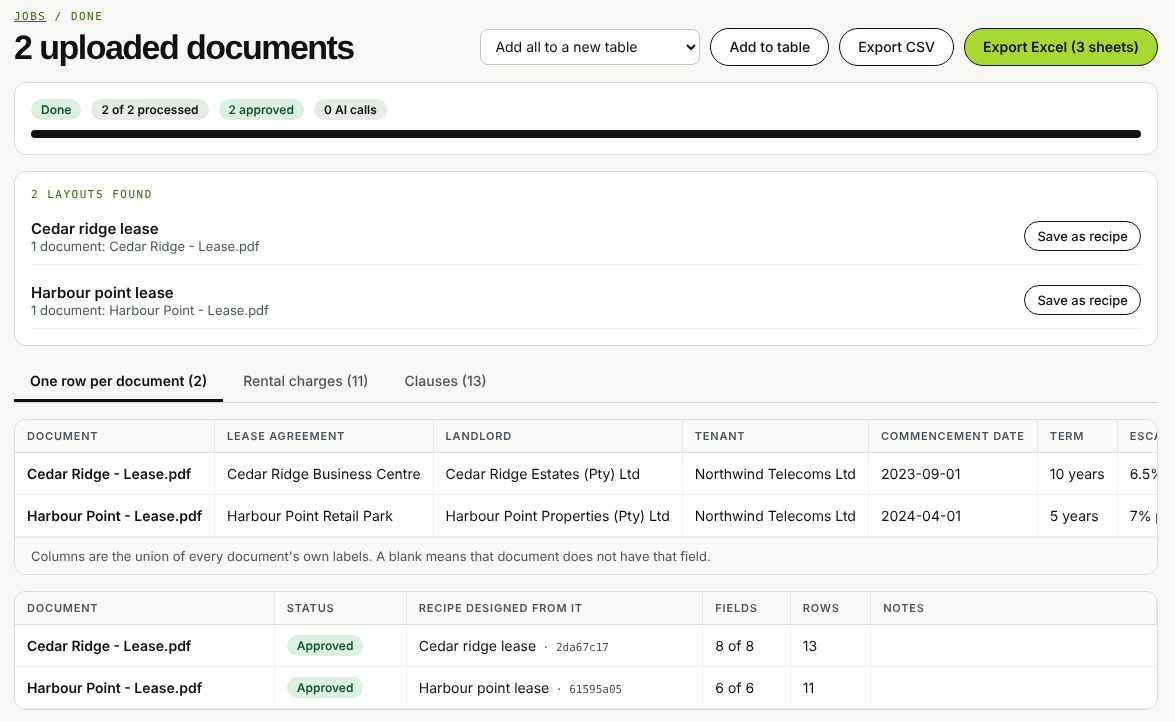
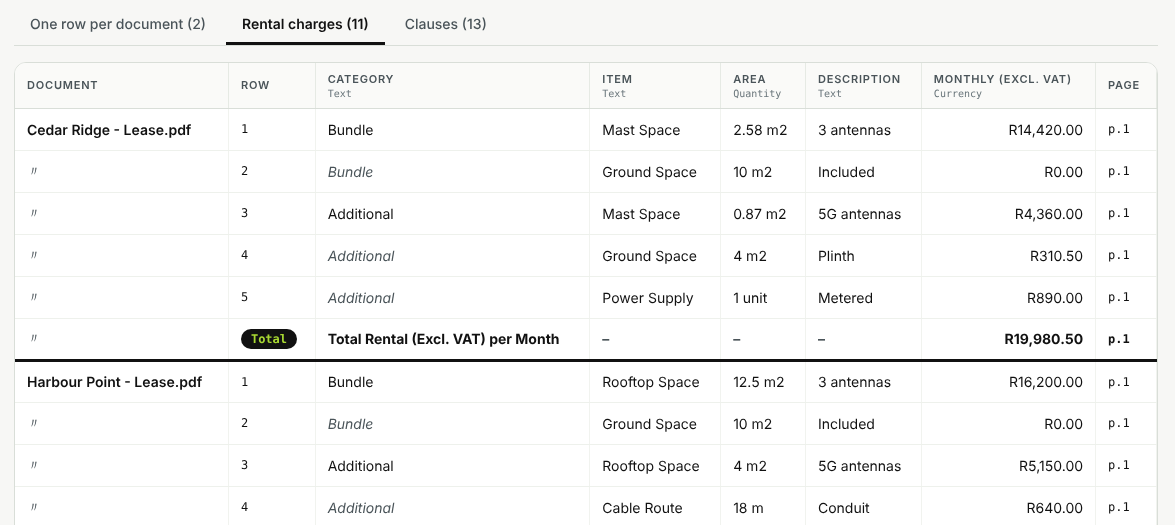
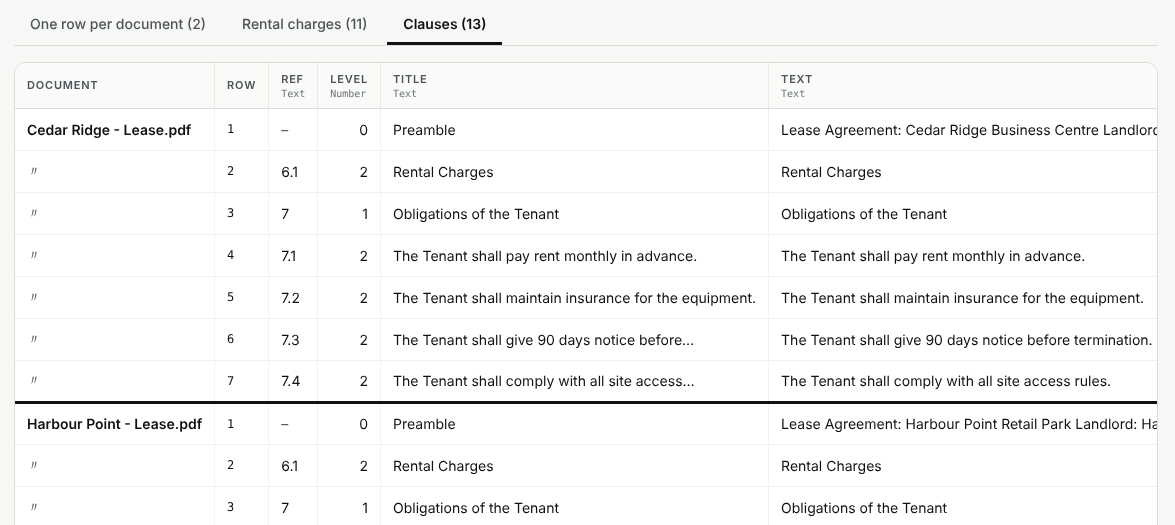
| Documents you upload, the requests you write, and the fields, tables and page images read from them | To provide the service: reading, extraction, checks, review and export |
| Billing contact and plan details. Card details go straight to Paystack; we never see or store your card number | To charge for paid plans and send invoices |
| Sign-ins, the address (IP) and browser they came from, and changes made in your workspace (the audit log) | Security, and so your workspace's admins can see who did what |
| API keys (stored only as a hash), webhook addresses and the destinations you connect | To connect DataDustie to your own systems |
| Your details if you ask us to contact you (name, email, company and what you want to extract) | To reply to you and set up your workspace |
We do not sell personal information, show advertising, or use analytics or tracking cookies. We do not use your documents, or the data read from them, to train AI models.
4. Why we may process it
Under POPIA section 11 we process account information because it is needed to provide the service you signed up for (the contract), to meet legal duties such as keeping tax records, and for our legitimate interest in keeping DataDustie secure. We process the documents you send only on your organisation's instructions, as its operator.
We collect only what we need for these purposes (section 10) and do not use it for anything unrelated (section 13).
5. How documents are read
When you start a task, DataDustie reads each document in three steps:
- Text. Digital PDFs and Word files are read from their own text, on our servers. Scans and photos are also read with OCR on our servers, as a rough guide to their text.
- Understanding. Your request and the text of your documents, plus the page images of scans and photos, are sent to Anthropic's Claude, which returns the fields, tables and issues you asked for. Follow-up questions in the same task send the conversation and the last result as well.
- Checks. Totals and your rules are checked by DataDustie's own code, on our servers.
Under its commercial terms, Anthropic may not use the information we send to train its models. It processes it in the United States.
6. How documents are protected
Information travels over encrypted connections (TLS). Every stored file is encrypted (AES-256-GCM) with a key that belongs to your workspace alone, and that key is itself encrypted with a master key held outside the database. Task titles and messages are sealed with the same workspace key. Values read from documents are kept separately for each workspace, and the database refuses to show one workspace's data to another. Owners and admins must use two-step sign-in, and document content is never written to our logs.
7. Information from Google and Microsoft
DataDustie's use and transfer of information received from Google APIs adheres to the Google API Services User Data Policy, including the Limited Use requirements. We use Google and Microsoft data only to sign you in, to read the files and folders you choose, and to write results to the destinations you connect. Folder access is read-only. We do not use this data for advertising, do not sell it, do not let people read it except where you ask us to (for support) or the law requires it, and do not use it to train AI models.
8. Who helps us, and where
We use these service providers (under POPIA, operators acting for us or for your organisation). Each is bound by contract to protect the information and use it only to provide their service:
| Provider | What for | Where |
|---|---|---|
| Railway | Hosting the app, database and encrypted file storage | European Union (Netherlands) |
| Anthropic (Claude) | Reading your request and your documents (their text, and the page images of scans and photos), and returning the fields, tables and checks you asked for | United States |
| Resend | Sending account emails, and receiving documents emailed to a connector's address | United States |
| Paystack | Taking card payments for paid plans | South Africa and Nigeria |
| Sign-in with Google, and Google Drive, only if you use them | Global | |
| Microsoft | OneDrive, SharePoint and Dataverse, only if you connect them | Global |
| Have I Been Pwned (Pwned Passwords) | Checking a new password is not in a known data breach: only the first 5 characters of the password's hash are sent, never the password | Global |
If your organisation connects DataDustie to another service (for example Airtable, Google Sheets, Databricks, Dataverse, Zapier, Make, n8n, Power Automate or your own webhook), the data it chooses to send there is handled under that service's terms. We will update this list before adding a provider that handles your documents; see our data processing agreement.
9. Information sent outside South Africa
DataDustie is hosted in the European Union, and some providers above process information in the United States or elsewhere. POPIA section 72 allows this where the recipient is bound by law, binding rules or an agreement that gives protection substantially similar to POPIA. We rely on our providers' data processing agreements, which include those protections, and on the EU's data protection law for hosting. By using DataDustie your organisation instructs us to make these transfers to provide the service.
10. How long we keep it
| What | How long |
|---|---|
| Original documents uploaded for reading | Deleted as soon as they are read, or after 7 or 30 days if your workspace chooses |
| Page images used in review | 30 days |
| Values and tables read from documents, and task conversations | Until your workspace deletes them, or for 30, 90 or 365 days if it sets a limit |
| Audit log | 12 months |
| Sign-in sessions | 24 hours, or 30 days if you choose to stay signed in |
| Connected-folder sign-in tokens | Until the connection is removed |
| Billing records | 5 years, as tax law requires |
| Your account | Until you or your workspace's owner deletes it |
| Backups | Up to 3 months, then overwritten |
When a workspace is closed, its documents and data are deleted within 30 days, and disappear from backups when those are overwritten.
11. If something goes wrong
If we have reason to believe personal information has been accessed or acquired by someone without authority, we will tell the affected organisation or person, and the Information Regulator where POPIA section 22 requires, as soon as reasonably possible. For documents your organisation sent us, we tell your organisation first so it can meet its own duties.
12. Your rights
Under POPIA you may ask:
- whether we hold personal information about you, and for a copy of it;
- for it to be corrected or deleted;
- us to stop processing it, or object to how it is processed;
- not to receive direct marketing (we send none unless you ask).
Email info@digera.ai. We reply within 30 days and may ask you to confirm who you are. For documents your organisation sent us, we pass your request to your organisation, which decides on it. Our manual under the Promotion of Access to Information Act (PAIA) is available on request.
If you are not satisfied, you may complain to South Africa's Information Regulator at inforegulator.org.za (complaints.IR@inforegulator.org.za).
13. Cookies
DataDustie uses only the cookies it needs to work: one that keeps you signed in, one that protects forms against forged requests, and short-lived ones while you sign in with Google or Microsoft. Your choice of light or dark theme is kept in your browser. There are no analytics, advertising or tracking cookies.
14. Children
DataDustie is a business service and is not meant for anyone under 18. If documents your organisation sends contain children's personal information, your organisation must have the authority POPIA section 35 requires.
15. Changes
We will post changes here with a new date and, for important ones, email account owners at least 30 days before they take effect.
16. Contact and Information Officer
Digera · Information Officer · info@digera.ai · digera.ai
Questions or concerns?
If you have any questions about this page, please contact us at info@digera.ai. We're happy to help.